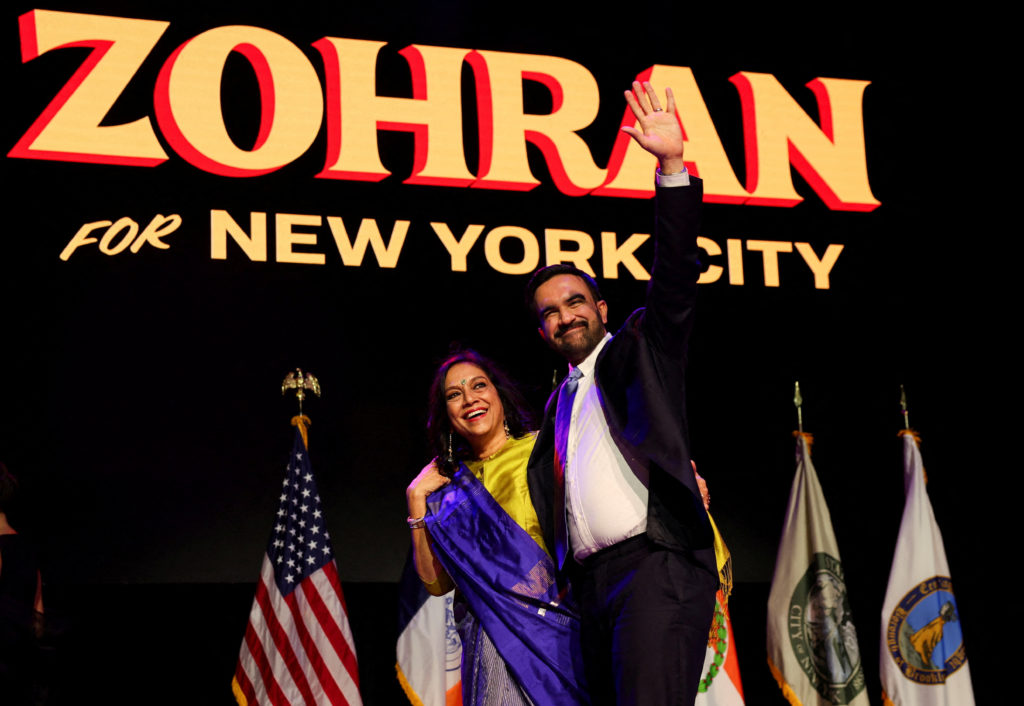
Like many, I have watched from afar the rise and now victory of Zohran Mamdani. It is genuinely remarkable how good he is at politics.
Fundamentally, I think the triumph of Zohran Mamdani in the New York City mayoral race represents a potentially decisive rejection of the Democratic Party establishment’s decades long neoliberal project of “managing decline”. It was the result of years spent building credibility on real, material concerns like rent and childcare (called “sewer socialism“).
Because I’m a long way away from New York City and the US, I’ve read and watched a lot of commentary and analysis to try to better understand why he’s been so effective and why he’s won. (When I visited NY for a week last year (before the 2024 US Federal Election), I was absolutely struck at the extreme level of homelessness. Talking to New Yorkers, they all brought up the unaffordably high and rising rent.)
Mamdani’s success in my view, was not due to his charm or viral social media videos, although the branding, communications and marketing, his fresh online presence and the viral videos were very important.
The “magic” of Mamdani was his “understanding that the masses are the message”. He ran a truly hyper-local campaign, meeting people in bodegas and on busy sidewalks, listening to their unglamorous but urgent concerns about rent and childcare. The very first video I saw of Mamdani was him going on a street walk through Queens, talking to the local residents. One of his first campaign videos was asking voters why they voted for Trump.
Rather, he won because he spent years building credibility with everyday New Yorkers through an institution, the Democratic Socialists of America (DSA), and through relentless focus on real, material concerns that New Yorkers (and across the US and most other countries) felt: affordability, rental costs, childcare costs, transport costs, grocery costs. In short: cost of living.
The backlash from the political establishment (like Cuomo) and the Wall Street financiers (like Bill Ackman) was the inevitable backlash against a class who keenly understand that Mamdani’s policies do not threaten their wealth but their power.
Even distant observers of US and New York politics have seen that the political apparatus of the status quo Democratic Party has become utterly exhausted, bereft of ideas, values and vision. They have become functionally controlled by billionaire donors, partly because of “Citizens United” that allows unlimited dark money super-PACs to spend during elections but also because US politics since the end of WW2 ultimately is about protecting the existing privileges of US capital.
The consequence is that the Democrats leadership approaches voters as a problem to be managed, with the tools of that management being polling, advertising and the bloodless promise of “competent governance”. The result is a party that appears “listless and unprincipled, unwilling to fight because they do not believe in anything”.
This lack of conviction led to the self-defeating strategy of “popularism,” demanding that candidates refine their platforms to the non-existent “median of public opinion”. This inevitably means accommodating the increasingly right-wing Republicans, so the Democrats “shift right”.
Mamdani’s victory proves that voters (in New York at least) are sick of being told what isn’t possible by a political elite. Mamdani and the people who voted for him rejected this entirely, embracing the radical possibility that reality “can be changed“.
This is important. The big underlying fault in politics in the global north (especially Anglophone countries) is a dissatisfaction and despair at the current system. Politicians that promise to blow up the system — like Trump, Millei in Argentina, Geert Wilders in the Netherlands, Farage in the UK — are tapping into that sentiment.
When the centre and centre-left just promise better management of a system that an increasing number of people think is utterly failing, it is little wonder that they’re struggling electorally.
Mamdani’s opponent, former Governor Andrew Cuomo, was the embodiment of this self-dealing, failed neoliberal political system. The more than $61 million in funding from the ultra-rich, including an $13.3m “donation” (attempt to buy the election) from Michael Bloomberg, was a very blatant attempt by the New York elites to stop everyday people from gaining any kind of political power. The oligarchy/plutocracy openly worked to purchase the electoral outcome that would financially benefit them.
When Mamdani won with over 50 percent of the vote (powered especially by young people) and spurred a turnout not seen in half a century, it was a rebuke of the people who see themselves as New York’s rightful masters.
Trump, ICE and Gaza: Three additional factors obviously were in play during the NYC election.
- Trump and his proto-fascism is obviously deeply unpopular, especially in large, cosmopolitan cities like New York. Progressive, liberal New Yorkers want a candidate (and a Democratic party) who will fight back hard against Trump.
- ICE is also deeply unpopular, especially in a city like New York. Mamdani’s confrontation with ICE-head Tom Homan earlier in 2025 is evidence that he has the courage of his convictions — he walks the talk.
- Finally, there is absolutely no doubt that Mamdani’s position on Israel’s genocide in Gaza played a big role in the election. His position was one of the main sources of attacks by his opponents, but more than that, Mandani refused to water down his position, again showing that he was authentic and would stand up for his convictions. While many voters in New York, especially older ones, would have marked this against Mamdani, he is far closer to the views of younger voters and increasingly, younger Jewish New Yorkers, when it comes to Gaza and Israel.
The Clarity of the Policy
From what I’ve seen and read about Mamdani’s campaign, his effectiveness was in grounding his vision the stark, concrete reality of material suffering in the global capital of finance. His campaign message was simple, clear, and repeatable: “free buses, universal childcare, freeze the rent“. And to pay for it all? A 2 percent tax on incomes over $1 million — a very, very modest tax on the richest.
These were not poll-tested abstractions and they weren’t traditional culture war zones. They were a direct confronting the new Dickensian conditions afflicting New Yorkers, where “one in four residents lives in poverty and one in 24 residents is a millionaire“.
He did not shy away from his identity as a young, Ugandan-born Muslim democratic socialist. Indeed, Mamdani’s identity was the key that made his materialist message authentic to the immigrant communities in New York. Being brown and Muslim and an immigrant in America allowed him to simultaneously attack the plutonomy in Wall Street and the racist structures that enable financial capitalism. His identity and faith in New York is a direct structural confrontation with the post-911 security state.
He refused to let his opponents dictate the terms of the political debate. (It is worth noting just how virulent and disgusting many of the attacks against him were.) Unusually for centre-left campaigns, when critics denounced his plans as “unrealistic,” Mamdani simply treated their attacks as “unpaid advertising” — he leaned into them rather than trying to fact-check them, or explain them away, or water them down.
Mamdani understood that the task of a leader is to communicate truthfully, “without condescension“, about the possibility of change and the aspiration for a life and condition better than what you have now. He focused on the “unglamorous but urgent day-to-day issues” — the sewer socialism.
His policy program resonated because it offered a “positive vision for making your lives better” and restored hope, insisting that “no longer would politics be something that is done to us. Now, it is something that we do”. It was more than the performative hatred that Democrats have served up since 2016.
In his victory speech, Mamdani spotlighted the working people whose “fingers bruised from lifting boxes on the warehouse floor. Palms calloused from delivery bike handlebar knuckles scarred with kitchen burns,” asserting that these hands must now hold power. No wonder Wall Street hates him!
The Organising Institution
I am a big believer that long-lasting, big, important change is only achieved through institutions. For working people, those institutions are unions and socialist/social democratic political organisations.
Mamdani’s victory further reinforces my view. There is no doubt that he only won because of the disciplined, long-term organisation that exists in New York’s Democratic Socialists of America. This political institution was able to lead the mobilisation of a huge volunteer force of “more than 100,000 volunteers” who knocked on “nearly 3 million doors”.
This army of volunteers helped expand the electorate — a vital task when enrolment and voting are both voluntary. The campaign brought in young people and new voters who are often ignored by establishment politics. The campaign’s grassroots power and success were the “end result of almost a decade of NYC-DSA’s trial-and-error on our campaigns“. This ground game allowed Mamdani to communicate his policies person-to-person, reinforcing his message and reaching the South Asian uncles and aunties, the Haitian chefs, the Yemeni bodega owners, who had previously felt forgotten by the political elites and billionaires. And it got them to actually vote!
The NYC-DSA’s institutional structure converted political excitement about Mamdani into sustained and organised action. The mayoral race wasn’t the first time it had done this. The NYC-DSA’s co-governance model has a track record of pushing its legislative goals by “building up this movement”.
The DSA-backed “co-governance model” sees elected officials not as islands, but as embedded parts of grassroots social movements, employing an “inside-outside strategy”. (This is obviously not new or innovative to the DSA — it is a standard model for social-democratic parties, especially those with union affiliations, across the world.)
This approach was vital to Mamdani’s success as a local politician before running for mayor, because the elite establishment’s model is “fundamentally based on treating working people as passive consumers to whom experts try to sell a political product dreamed up in a boardroom with millionaire and billionaire donors”. Mamdani’s win, despite being vastly outspent, confirms that strong organisation, a political institution, and popular engagement can be effective counterweights to plutocratic financial power.
I also acknowledge that there were a range of other organisations that supported Mamdani’s grassroots efforts. Unions, the NYC Working Families Party, community groups — all institutions — were a part of his coalition. It wasn’t just his campaign or the DSA.
(Aside: It’s also worth pointing out that organisations like DSA have been criticised, rightly so, for being often dominated by the professional-managerial class”, as noted by the likes of Vivek Chibber. I obviously don’t have any familiarity with the NYC-DSA, but I certainly have heard and read that most US (and western) socialist organisations have relatively little connection to the working classes and proletariat. Nonetheless, these kinds of socialist organisations are useful connective tissue between the PMC and the precariat and other working people.)
The “Bond Vigilantes”
Mamdani enters City Hall having defeated the Wall Street elites and Democrat party’s New York dynasty at the ballot box, but he will now immediately confront the “structural veto” held by Wall Street.
This is the first challenge he will face. New York City (and all sub-national governments), unlike the federal government, cannot print its own money and must borrow heavily, funding its public infrastructure and social programs through the $4 trillion municipal bond market.
This is a problem everywhere — and in Victoria where I live, the bond markets and ratings agencies are a major political and financial barrier to us having nice things.
New York spends nearly “$4 billion a year on interest payments to Wall Street alone“. Before any tax revenue can be spent on Mamdani’s agenda, like universal childcare or free buses, the council must first pay the financiers. This gives those financiers effective veto power over social policy, a tool purposely designed to destroy his anti-poverty agenda.
The history of the 1975 fiscal crisis serves as a cautionary tale. In that crisis, the banks “locked the city out of the credit market and forced New York to make cuts to the satisfaction of the banking sector”. Mamdani is now going to be responsible for this dilemma. He will face inevitable and massive pressure from creditors and credit ratings agencies to “reign in costs” and impose austerity. This debt trap is a “structural challenge” that threatens to destroy his anti-poverty agenda.
And to be clear: the austerity demands from Wall Street are purposely designed to politically destroy him by the same plutocrats that financed the election campaign against him. Money is not neutral when it comes to power.
To implement his agenda, Mamdani will need to succeed in implementing the tax increase on the ultra-wealthy and corporations. But even tax increases for the top incomes, while necessary, may only “barely slow inequality”. As economist Nancy Folbre notes, a 2 percent tax is “like shaving off a fraction of a spire from a large cathedral”. (The Mamdani tax proposal however is not a wealth tax, it is still an income tax, so it fundamentally doesn’t impact on the wealth-power nexus for those billionaires.)
Mamdani’s path forward likely necessitates building a powerful debtor’s movement capable of challenging Wall Street directly. Or he and other progressive mayors could try to build public finance organisations, like those suggested by people like Yanis Varoufakis. He will also need to confront the monopoly capitalists, something spelled out with great clarity by Matt Stoller.
The second major challenge that I see for Mamdani is filling his administration with like-minded people who are “with the program” while also being equipped with the competence and experience” needed to govern effectively and challenge New York’s entrenched, pro-Wall Street bureaucracy.
So far, his transition team, co-chaired by former FTC chair Lina Khan who I think is not too bad, is a good sign, although there are also some people who look like they’re from the “charity-industrial-complex”.
Mamdani and the NY-DSA ‘s philosophy of co-governance, which bypasses the typical transactional politics of the establishment and traditional New York political elite, will be tested by the daily grind of running the largest city council in the USA — around $250 billion per year — not to mention the jewel in the crown of global financial capital.
The third challenge I see is Mamdani being effectively co-opted by the political machine, effectively becoming yet another centre-left manager of the crisis rather than tackling its causes. If that happens, ultimately nothing will change and his programme will be discredited.
While the right parades the boogeyman that Mamdani is the second coming of Lenin, the greater risk is that he just keeps the zombie of neoliberalism limping along, extending its legitimacy and securing a few more years of consent.
Free buses and universal childcare will make a real difference, but it is just the same social democratic policy programme that in other countries and councils is just “managing the crisis”, albeit with more compassion. Basically, he must avoid Obama-ism.
Unless he does something to fundamentally and significantly reduce the power of the plutocrats in Wall Street, there is a strong possibility that he will be forced to implement cuts, austerity and wind back or not implement his programme. Then the lesson will be “socialism doesn’t work”.
Ultimately, I think there’s a range of events and structural contradictions that together allowed for Mamdani and his team to win.
The ideological and strategic vacuum left by the neoliberal Democratic establishment. This establishment clearly failed to deliver material improvements for New Yorkers or create a compelling and bold vision. Instead they relied on safe, poll-tested blandness and political patronage.
This failure — not unique to the Democrats by any means — created a deep-seated popular discontent. In other places and times the ultra-right harnessed the anger, and in New York it was harnessed by Mamdani.
Mamdani and his team understood the real concerns of everyday people and used this to create a a powerful, authentic political program rooted in concrete, material demands. Free buses, universal childcare, rent freeze, and paid for by miniscule taxes on the ultra-rich. His approach was a triumph of organisation over financial capital, proving that while money can often triumph, it is not predetermined.
The billionaires can be defeated when popular enthusiasm is channelled into disciplined, grassroots action by a coherent political organisation. The Democratic Socialists of America (DSA) provided the institutional organising muscle and leadership.
However, Mamdani’s electoral victory is only a step in a long struggle for a fairer New York. It is absolutely clear that the financiers, monopolists and the plutocrats will directly confront Mamdani, and attempt to block him. They will use the full structural power of global finance. New York City’s massive debt gives the Wall Street Bond “Vigilantes” effective veto power. They will insist on austerity to destroy Mamdani.
His ability to negotiate and manoeuvre through this depends on whether the electoral coalition and his mayoral office team can build sufficient counter-power to withstand the inevitable pushback.
Why did Mamdani win?
Partly his authenticity. Partly his willingness to embrace “agonistic politics” (to paraphrase Chantal Mouffe) and be prepared to take on a real fight with the established oligarchy. Partly his bold platform, which presented a compelling vision to people looking for an alternative to the dystopia of endless rental increases. Partly that he didn’t condescend the voters in New York, and instead treated them like adults that could understand what he was promising and the trade-offs it needs.
But beyond Mamdani as a candidate, what really strikes me about his win is the importance of institutionalising the fight against financial plutonomy and oligarchy.
People who want to change things to be better must focus strategic energy and resources on building durable, permanent institutions that are capable of confronting the structural constraints of capital. Unions, the DSA, renters unions, community mutual aid organisations and the like. This is the only long-term path to counter the bond vigilantes, break the debt trap, and prevent the lesson from becoming: “socialism doesn’t work”.
For sub-national politics, the primary driver of austerity policies are the bond markets, the debt trap and the fear of capital flight. We need alternative means to finance state and local government projects and infrastructure, but we more importantly need institutions and organisations able to imagine those alternatives and organise together to build them.
There is a potential for Mamdani’s victory to be a moment of decisive rupture, but I wouldn’t bet on it, yet.
No doubt, there is every possibility that he will introduce better policies, make the buses free, introduce government-run grocery stores and improve public transport. But his program, while radical for the US, is modest in the extreme. It is not a fundamental challenge to social relations or the real power of Wall Street. And as important as New York is (it’s size and budget alone!), a change in NYC does not necessarily change US policy or politics.